

Which Cell Component Is Found In Plant Cells But Not In Animal Cells?
Learning Outcomes
- Identify key organelles present only in animal cells, including centrosomes and lysosomes
- Identify fundamental organelles present just in plant cells, including chloroplasts and large central vacuoles
At this point, you know that each eukaryotic cell has a plasma membrane, cytoplasm, a nucleus, ribosomes, mitochondria, peroxisomes, and in some, vacuoles, just there are some striking differences between beast and found cells. While both animal and institute cells take microtubule organizing centers (MTOCs), animate being cells also have centrioles associated with the MTOC: a complex chosen the centrosome. Animal cells each have a centrosome and lysosomes, whereas constitute cells practice not. Establish cells take a jail cell wall, chloroplasts and other specialized plastids, and a big central vacuole, whereas creature cells do not.
Backdrop of Fauna Cells

Figure ane. The centrosome consists of two centrioles that prevarication at right angles to each other. Each centriole is a cylinder made upwards of nine triplets of microtubules. Nontubulin proteins (indicated by the green lines) hold the microtubule triplets together.
Centrosome
The centrosome is a microtubule-organizing centre found near the nuclei of animal cells. It contains a pair of centrioles, two structures that prevarication perpendicular to each other (Figure 1). Each centriole is a cylinder of nine triplets of microtubules.
The centrosome (the organelle where all microtubules originate) replicates itself before a cell divides, and the centrioles announced to have some role in pulling the duplicated chromosomes to opposite ends of the dividing cell. However, the exact function of the centrioles in cell division isn't articulate, considering cells that have had the centrosome removed can all the same divide, and plant cells, which lack centrosomes, are capable of cell division.
Lysosomes

Figure two. A macrophage has engulfed (phagocytized) a potentially pathogenic bacterium and and then fuses with a lysosomes within the prison cell to destroy the pathogen. Other organelles are present in the cell but for simplicity are not shown.
In add-on to their role as the digestive component and organelle-recycling facility of fauna cells, lysosomes are considered to be parts of the endomembrane system.
Lysosomes also employ their hydrolytic enzymes to destroy pathogens (affliction-causing organisms) that might enter the jail cell. A skillful example of this occurs in a group of white blood cells called macrophages, which are function of your body's immune system. In a process known as phagocytosis or endocytosis, a section of the plasma membrane of the macrophage invaginates (folds in) and engulfs a pathogen. The invaginated section, with the pathogen inside, then pinches itself off from the plasma membrane and becomes a vesicle. The vesicle fuses with a lysosome. The lysosome's hydrolytic enzymes so destroy the pathogen (Effigy 2).
Properties of Plant Cells
Chloroplasts
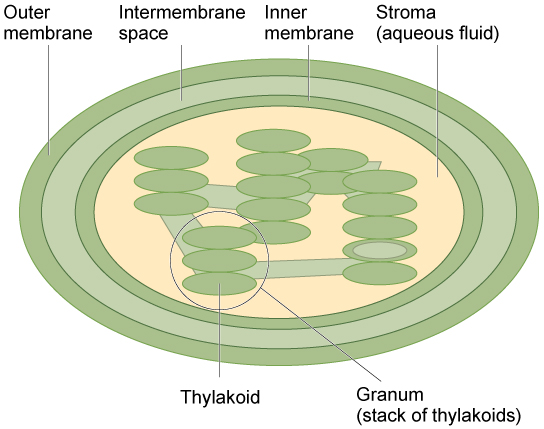
Figure 3. The chloroplast has an outer membrane, an inner membrane, and membrane structures chosen thylakoids that are stacked into grana. The space within the thylakoid membranes is called the thylakoid infinite. The lite harvesting reactions take place in the thylakoid membranes, and the synthesis of sugar takes place in the fluid inside the inner membrane, which is called the stroma. Chloroplasts besides accept their own genome, which is contained on a single round chromosome.
Like the mitochondria, chloroplasts have their own Deoxyribonucleic acid and ribosomes (we'll talk about these afterward!), just chloroplasts accept an entirely different function. Chloroplasts are plant cell organelles that carry out photosynthesis. Photosynthesis is the series of reactions that apply carbon dioxide, water, and calorie-free free energy to make glucose and oxygen. This is a major difference betwixt plants and animals; plants (autotrophs) are able to make their own food, like sugars, while animals (heterotrophs) must ingest their food.
Like mitochondria, chloroplasts take outer and inner membranes, but within the infinite enclosed by a chloroplast'south inner membrane is a ready of interconnected and stacked fluid-filled membrane sacs called thylakoids (Effigy 3). Each stack of thylakoids is called a granum (plural = grana). The fluid enclosed past the inner membrane that surrounds the grana is called the stroma.
The chloroplasts comprise a green pigment called chlorophyll, which captures the calorie-free free energy that drives the reactions of photosynthesis. Like plant cells, photosynthetic protists also take chloroplasts. Some bacteria perform photosynthesis, but their chlorophyll is not relegated to an organelle.
Endeavor It
Click through this activity to learn more than nigh chloroplasts and how they work.
Endosymbiosis
Nosotros have mentioned that both mitochondria and chloroplasts contain Dna and ribosomes. Have you wondered why? Stiff bear witness points to endosymbiosis every bit the explanation.
Symbiosis is a relationship in which organisms from two split species depend on each other for their survival. Endosymbiosis (endo– = "within") is a mutually beneficial relationship in which one organism lives within the other. Endosymbiotic relationships abound in nature. We have already mentioned that microbes that produce vitamin 1000 live inside the homo gut. This relationship is beneficial for united states because nosotros are unable to synthesize vitamin Yard. It is besides beneficial for the microbes because they are protected from other organisms and from drying out, and they receive abundant food from the environment of the large intestine.
Scientists have long noticed that bacteria, mitochondria, and chloroplasts are similar in size. We also know that bacteria have Deoxyribonucleic acid and ribosomes, merely as mitochondria and chloroplasts exercise. Scientists believe that host cells and bacteria formed an endosymbiotic relationship when the host cells ingested both aerobic and autotrophic bacteria (cyanobacteria) but did not destroy them. Through many millions of years of evolution, these ingested leaner became more than specialized in their functions, with the aerobic bacteria becoming mitochondria and the autotrophic bacteria condign chloroplasts.
Figure 4. The Endosymbiotic Theory. The first eukaryote may accept originated from an ancestral prokaryote that had undergone membrane proliferation, compartmentalization of cellular function (into a nucleus, lysosomes, and an endoplasmic reticulum), and the establishment of endosymbiotic relationships with an aerobic prokaryote, and, in some cases, a photosynthetic prokaryote, to grade mitochondria and chloroplasts, respectively.
Vacuoles
Vacuoles are membrane-bound sacs that function in storage and ship. The membrane of a vacuole does not fuse with the membranes of other cellular components. Additionally, some agents such every bit enzymes within plant vacuoles interruption down macromolecules.
If you look at Figure 5b, you will run across that establish cells each have a big central vacuole that occupies most of the expanse of the jail cell. The primal vacuole plays a key part in regulating the prison cell'south concentration of water in changing environmental conditions. Have you ever noticed that if you forget to h2o a plant for a few days, information technology wilts? That's considering as the h2o concentration in the soil becomes lower than the water concentration in the institute, water moves out of the central vacuoles and cytoplasm. As the key vacuole shrinks, it leaves the cell wall unsupported. This loss of back up to the cell walls of constitute cells results in the wilted advent of the constitute.
The central vacuole also supports the expansion of the jail cell. When the central vacuole holds more water, the cell gets larger without having to invest a lot of energy in synthesizing new cytoplasm. You lot tin rescue wilted celery in your refrigerator using this procedure. Simply cut the end off the stalks and place them in a loving cup of water. Soon the celery will exist stiff and crunchy again.

Effigy 5. These figures testify the major organelles and other jail cell components of (a) a typical brute cell and (b) a typical eukaryotic plant cell. The plant jail cell has a prison cell wall, chloroplasts, plastids, and a central vacuole—structures not found in creature cells. Plant cells do non accept lysosomes or centrosomes.
Try Information technology
Contribute!
Did y'all accept an idea for improving this content? Nosotros'd honey your input.
Better this pageLearn More
Source: https://courses.lumenlearning.com/wm-biology1/chapter/reading-unique-features-of-plant-cells/
Posted by: childsrecare68.blogspot.com
0 Response to "Which Cell Component Is Found In Plant Cells But Not In Animal Cells?"
Post a Comment