

How Is Refraction Used In The Natural World By Animals
At Christmas, thousands of greetings cards feature the iconic winter plumage of the robin. But non all the robins you might discover in your backyard are permanent natives to your land. In the UK, for instance, some will accept migrated from Frg and Russia, and like millions of other animals all over the earth, volition return back to their breeding grounds adjacent bound. This ebb and flow of birds, mammals, fish and insects is a cardinal function of the Earth's biodiversity.
Migration is a challenging strategy. For modest animals like songbirds to exist able to return from Africa or southern Europe to areas where they tin successfully brood, they need to be able to repeatedly navigate to precisely the same place. How they do this is a question that has vexed scientists for over 60 years.
But recent evidence is shedding light on how tiny animals – with correspondingly tiny brains – can cross mountains, oceans and deserts without getting lost.
It seems that birds employ external cues available in their environment, like the stars and the World'due south magnetic field, to provide them with the equivalent of a map and a compass. But how they combine these cues is but now starting to become clear.
Our inquiry group's recent paper focuses on how reed warblers, a small Eurasian songbird, navigate. First, we disrupted the birds' ability to sense the Globe's magnetic field past attaching a small magnet to their forehead.
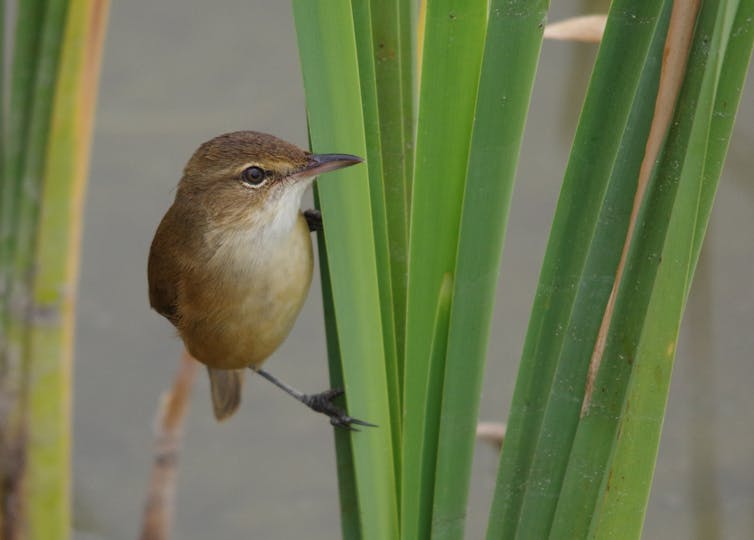
The reed warbler is 1 of many birds that use the Earth'due south magnetic field to navigate. Gary Tate/Wikimedia
We found that when we too obscured their view of the stars, the birds were unable to observe the correct direction to migrate in. In one case their view of the stars was returned, even so, they were able to detect their way over again.
Like a careful engineer, the evolutionary process of natural option has built in a fail-prophylactic to birds' navigation systems, making sure at that place are backup orientation devices available for when the skies are cloudy.
Magnetic fields
Another report by our research group has shown how these aforementioned reed warblers can piece of work out exactly where they are when migrating, as well as how they deal with existence diddled off course or needing to detour around barriers like the Alps.
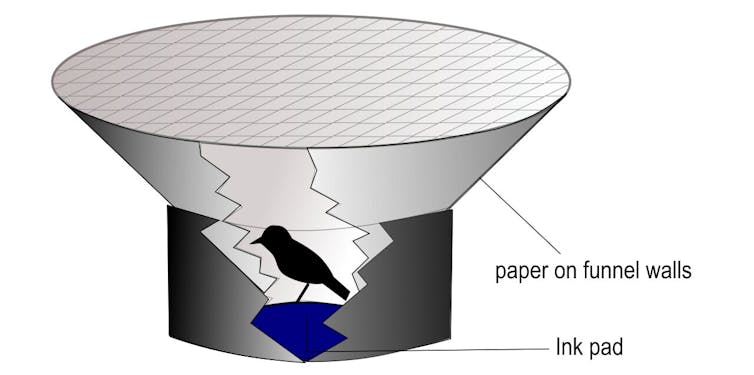
This is an example of a funnel used to test birds' orientation. Birds' feet leave ink marks on the funnel paper when taking off, indicating their flying direction. L Shyamal/Wikipedia
We put reed warblers in an artificial magnetic field that matched the natural magnetic field of a place far northwest of the birds' migration route. We then tested their sense of direction in an orientation cage – a small funnel 30cm in diameter that allows us to mensurate the direction a bird wants to take off in by analysing where information technology hops inside the muzzle.
We found that when placed in this artificial field, birds changed their orientation from southeast to southwest, suggesting they had recognised the magnetic field signature as strange and were trying to become back to their route.
We phone call this technique "virtual displacement", as the bird itself never actually leaves the site where it's captured for testing. It'south get a new tool for understanding how animals sense and use the Globe'due south magnetic field for navigation.
What was fifty-fifty more than remarkable was that the artificial magnetic field we created is not one that the birds would have previously encountered on their migrations. That ways they weren't reacting to magnetic field cues that they had learned. Instead, the birds had used their instinctive sensation of how the Earth's magnetic field changes with distance to piece of work out that they were northwest of their road. Swell for those tiny bird brains.
Conspicuously, both the starfield and the magnetic field are of import cues for birds to migrate. But human action has the potential to disrupt these. Artificial calorie-free at nighttime from cities reduces visibility of the stars and moon. In other animals, such as dung beetles and sandhoppers, this has been shown to negatively bear upon navigation abilities.
What'southward more, bogus electromagnetic signals – such as those coming from radio towers or even from electric currents that ability everyday devices such as kettles – tin can also confuse birds' ability to detect the natural magnetic field. We may exist giving birds a double dose of pollution that even their fail-safe systems can't overcome.
We don't fully understand how these pollutants affect migratory birds yet, but as we come to understand more nearly nature's GPS, it'south vital to empathize the risks man action poses to this remarkable system of navigation.
Source: https://www.econotimes.com/Natures-GPS-how-animals-use-the-natural-world-to-perform-extraordinary-feats-of-navigation-1624250
Posted by: childsrecare68.blogspot.com
0 Response to "How Is Refraction Used In The Natural World By Animals"
Post a Comment