

Can Animals Acquire Human Language? Shakespeareã¢â‚¬â„¢s Typewriter
Can Animals Acquire Linguistic communication?
Despite claims that this is possible, the evidence says no
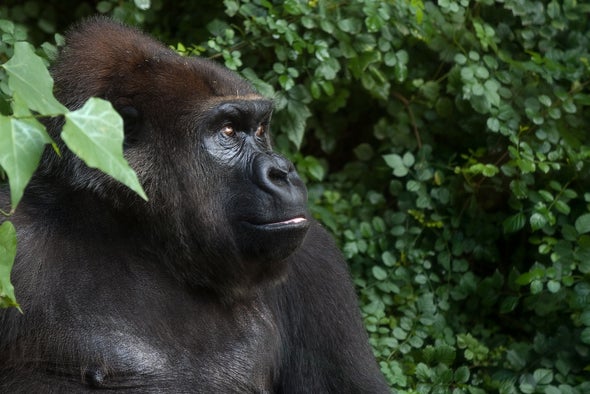
Man intelligence, even in its nearly bones forms, is expressed in our language, and is also partly dependent on our linguistic chapters. Homer, Darwin and Einstein could obviously not have achieved what they did without language—but neither could a child in kindergarten. And this raises an important question about animal intelligence. Although we don't await a chimpanzee to write an epic or a dolphin to develop a scientific theory, information technology has often been asked whether these or other animals are close in intelligence to young children. If so, we must wonder whether animals tin can acquire a language.
In the last half century, much effort has been put trying answer that question by teaching animals, primarily apes, a basic language. There have been some limited successes, with animals using signs to obtain things in which they were interested, for instance. But no brute has yet caused the linguistic capability that children have already in their third year of life.
"Why?"
This is a question children start request by the age of three at the latest. No animal has yet asked annihilation. "Why?" is a very important question: it shows that those asking it are aware they don't know something they wish to know. Agreement the why-question is also necessary for the ability to justify our deportment and thoughts. The fact that animals don't ask "why?" shows they don't aspire to knowledge and are incapable of justification.
"No!"
Children start saying no before they are ii years quondam. No brute has yet said no. In guild to master basic logic, one must understand negation. The inability of animals to apply negation shows they lack basic logical abilities.
If a person knows that either A or B, and later learns that A isn't the case, he'll infer that B holds. This is chosen a disjunctive syllogism or inference. Are animals capable of such an inference? In 2001 Watson, Gergely et al. published the results of the following study, conducted on dogs and on four- to six-year-old children (Journal of Comparative Psychology. The dogs and children were first shown a desirable object in a container; next, a person holding the container passed behind 3 screens; and and then the container was shown to exist empty. The dogs and children were then allowed to search for the object backside the screens.
While children tended to increase their speed of checking behind the third screen after failing to find the object behind the kickoff two, dogs tended to significantly decrease their speed of checking behind the third screen afterward thus failing. Nosotros know that children of this age are capable of a disjunctive inference, and this explains their search pattern. The contrasting dogs' search pattern is explained if the dogs did not retrieve logically but were motivated by mere association, and and then each failure to discover the object amounted to an extinction trial for the clan. 'In that location is as even so no compelling evidence for successful logical reasoning using the disjunctive syllogism in nonhuman animals' (Mody & Carey, Knowledge 2016).
Another essential characteristic of our language is its normativity—namely, the fact that there are right and incorrect uses of a give-and-take or phrase. Nosotros understand, for instance, that we used a certain word wrongly, or that we don't yet know how to use it. Animals' use of language does not accept this aspect. An animal might employ a sign the way we intended it to be used, or it might not notwithstanding use the sign that way. Simply the animal itself cannot understand that it doesn't know how to use the sign or that information technology has used it incorrectly. Understanding the idea of a mistake or of normativity depends on the ability to sympathize that something is non right, and since animals cannot empathize negation they cannot understand normativity.
Since normativity is essential to our language, animals don't have a language in the sense we do. Animals produce sounds that express their emotions, and some can utilise signs in a Pavlovian way, as a upshot of an clan between previous uses and succeeding events. Merely without "Why?" and "No!" at that place'south nothing resembling homo language.
And the distinctions don't stop there. To ascribe a mistake to another is to accredit him a belief which is not true. Accordingly, the disability to understand negation makes animals incapable of understanding that someone has a fake belief. Indeed, a report recently published in Science claimed apes tin can accredit a mistake to others. But empirical problems, also as faulty assay of the findings (see my response in Science)make the study'southward conclusions unsupported.
Some emotions also depend on the agreement of negation, possibility, and other logical concepts. For case, you hope that something will happen if you lot want it to happen only understand that it might not happen. And since animals cannot understand the notions of negation or of possibility, they cannot hope. Your dog expects you to have it out for a walk when you accept the leash off the hook, and that is why information technology gets excited. Just when yous take a nap it cannot hope that you volition take it out once you become up.
Ethics involves normative concepts, of what is right, just or off-white to practice, and of their contraries. And since animals do non understand such concepts, they are incapable of anything like human moral behaviour or related feelings. For example, if Alice clearly gave Bob more than she did Charlie, although it was equally clear that Bob did not deserve more than, Charlie volition become upset: it's not off-white! Such moral emotions, the result of injustice or lack of equity, are beyond the purview of animals.
Several studies have been conducted in order to testify that animals do accept such emotions, the best known probably beingness that of Frans de Waal and his colleagues with capuchin monkeys. Ane monkey gets furious when it continues to receive cucumbers later on it sees the other monkey receiving grapes for the same job. However, the monkey gets upset not because it thinks it was treated unjustly, just considering information technology expects grapes and receives cucumbers. The monkey doesn't initially get upset when it sees the other receiving a grape subsequently it received a cucumber; Charlie, by contrast, volition remonstrate when he sees Alice giving Bob more than she earlier gave him. Rather, the monkey gets upset only later, when it doesn't receive what it expects. Information technology cries in frustration, non with moral indignation.
We shouldn't immediately interpret behaviour that with united states of america would be the upshot of a specific feeling or belief as resulting, in similar circumstances, from the same feeling or belief in animals. We should rather first examine the animals in other circumstances equally well, to determine the limits of their capacities.
Animals can suffer, enjoy, be angry, surprised or afraid. Some are also sad when they lose their young. These and similar feelings bring us to love them, compassion them and endeavor to prevent them from suffering. Only their resemblance to humans stops at that place. Human being beings, as Aristotle observed and Descartes reiterated, are animals with a language. And language here is also logos, that is, logic or rationality. And experience teaches usa that these are absent from the residuum of the animal kingdom.
The views expressed are those of the author(s) and are non necessarily those of Scientific American.
Nearly THE Author(South)

Source: https://blogs.scientificamerican.com/guest-blog/can-animals-acquire-language/
Posted by: childsrecare68.blogspot.com
0 Response to "Can Animals Acquire Human Language? Shakespeareã¢â‚¬â„¢s Typewriter"
Post a Comment