

What Size Sand Filter For 16000 Gallon Pool
How to Cull The Right Size of Filter for Your Pool
Choosing the correct size pool filter for your pool is not ever a simple task, but information technology is crucial to ensuring that your pool stays safe, clean, and open up. The outset pace when picking the right sized pool filter is picking the right size puddle pump.
Choose the Right Size Pump
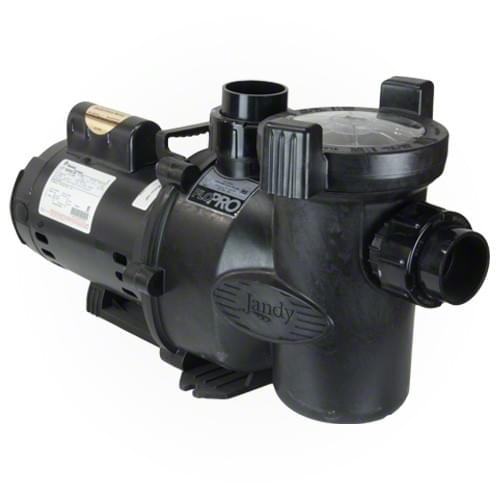
Many people err on the side of caution and buy a pump that is far bigger than what they need. This can be a costly mistake. Larger pumps are more expensive, and may increase your energy pecker compared to an accordingly sized pump. Worse, a pump that is too large can overpower your filter organisation. A pump that is too small may lack the power needed to effectively pump and filter your pool. This can lead to a buildup of bacteria and algae.
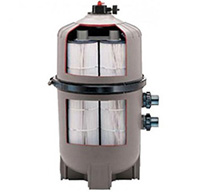
Cull the Right Size of filter
Fifty-fifty if you have the right sized pump, if you cull a filter that is too minor, the pump will generate too much pressure, causing the filtering material to break downwards and rendering the filter ineffective. The pressure build-upwardly caused by small filters causes pressure to build up in your pump, and in some cases this has resulted in explosions, or serious damage to your pump.
The correct sized filter and pump should be able to fully cycle all of your pool h2o in virtually eight hours. This simple guide volition show you how to find the right sized pump and filter for your puddle.
Step one: How Much Water Does Your Pool Concur?
The get-go step to picking the right size pool filter is determining how much water your pool actually holds. This is a relatively easy process if you lot have a nice simple rectangular pool, but gets progressively difficult the more intricate your pool layout is. Broadly speaking however, there are four pool shapes: rectangular, round, oval, and kidney. To make up one's mind the size of your pool there are some unproblematic formulas to use.
Pool depth: Regardless of the shape of your puddle you'll need to summate the average pool depth. To do this simply find the deepest function of the pool, and the shallowest part and detect the average between them. If the deep stop is 12 feet and the shallow end is four feet, so the average depth would exist 12+four = 16 and 16 ÷ two= 8.
Rectangular pools: You'll first have to mensurate the length and width of your pool. Remember that one-time formula from elementary school: A=L x W (Area= length x width)? Use it to detect the surface area.
Next, find the average depth of your pool. Multiply the average depth by the surface expanse to discover the total volume. Or, wrap it all into one formula: L x W x D = V. This is the volume of your pool. If your pool is "L" shaped then intermission information technology into ii (or more) rectangles and calculate the volume of each, then add together the volume together.
Round pools: Determining the surface are of your round pool requires a slightly more complex formula. Surface surface area (SA) = pi (which is 3.14) x the radius squared (r2). So your formula looks similar this: SA = 3.fourteen x r2. Then calculate the boilerplate depth of your puddle, and multiply it by the book.
Oval pools: Oval pools are a bit trickier, you'll accept to measure the longest diameter, shortest diameter, and average depth and use this formula: longest diameter x shortest diameter x average depth = volume.
Kidney shaped pools: Yous'll have to find the longest width, shortest width, and length of your pool. Then calculate the volume with the following formula: Volume = (longest width + shortest width) x length 10 average depth.
Step 2: Turn Cubic Feet into Gallons
Once you have calculated the volume of your pool in cubic feet, multiply that figure past vii.48 – which is how many gallons there are in one cubic pes.
Step 3: Gallons Per Infinitesimal
Once you have calculated your full puddle capacity in gallons yous demand to calculate the gallons per minute that you volition desire your pump to handle. Remember that most pool owners look to run their pump for no more than viii hours. Then that means you demand to decide how many gallons per minute you need. First separate your puddle's volume (in gallons) by 8, this volition give you gallons per hour. Then divide that number by sixty, because there are 60 minutes in an hour. The average puddle is about 20,000 gallons which means that 20,000 ÷ eight = 2,500 GPH (gallons per hour), and 42 GPM (gallons per minute).
For commercial pools, or other heavily used applications you ideally want to be able to run your pool 4 times within 24 hours, meaning y'all want a total pump in 6 hours or less.
Step 4: Anxiety of Head
You need to take into consideration the piping between the pool and the pump (called the feet of head). The more head you lot have, the more that GPM will decrease. You'll also have to take into consideration whatsoever fixtures and valves in the piping besides. Yous should at least have a rough judge of how many anxiety of piping are between your pool and pump.
Stride 5: Choose Your Pump
Once you know your GPM and feet of head you can start searching for the right pump. Most pump manufacturers and retailers will provide a chart indicating the pumps GPM capacity based on different foot of caput lengths. It is ever better, in one case you know your pool's capacity and pump requirements to buy a slightly larger pump.
Step 6: Choose Your Filter Size
Your pool filter size is directly related to the size of your pump. Too minor and the filter could break, and your pump could burn down out. There are less risks associated with buying a filter that is as well large than one that is as well small, so go along that in mind while finding your filter. Then match your filter to at least the pumping capacity of your pump, so if your pump is skillful for 42 GPM, become a filter that is rated for 42GPM or more.
Additional Factors to Consider
You should too take into consideration a number of other factors. If y'all take waterfalls, spas, or other water features then they will add together to your pools total GPM needs. If you have a very large pool (with a GPM that is more than than 60) then you may not simply demand a larger pump, but likewise ii" diameter pipes which can handle up to 100 GPM.


What Size Sand Filter For 16000 Gallon Pool,
Source: https://www.poolsuppliescanada.ca/how-to-choose-the-right-size-of-filter-for-your-pool.html
Posted by: childsrecare68.blogspot.com
0 Response to "What Size Sand Filter For 16000 Gallon Pool"
Post a Comment